Secure Data Storage for Backups
Secure data storage solution purpose-built for Veeam that enforces Zero Access to destructive actions, ensuring nobody can alter or delete backup data—even with admin credentials.
Secure data storage solution purpose-built for Veeam that enforces Zero Access to destructive actions, ensuring nobody can alter or delete backup data—even with admin credentials.
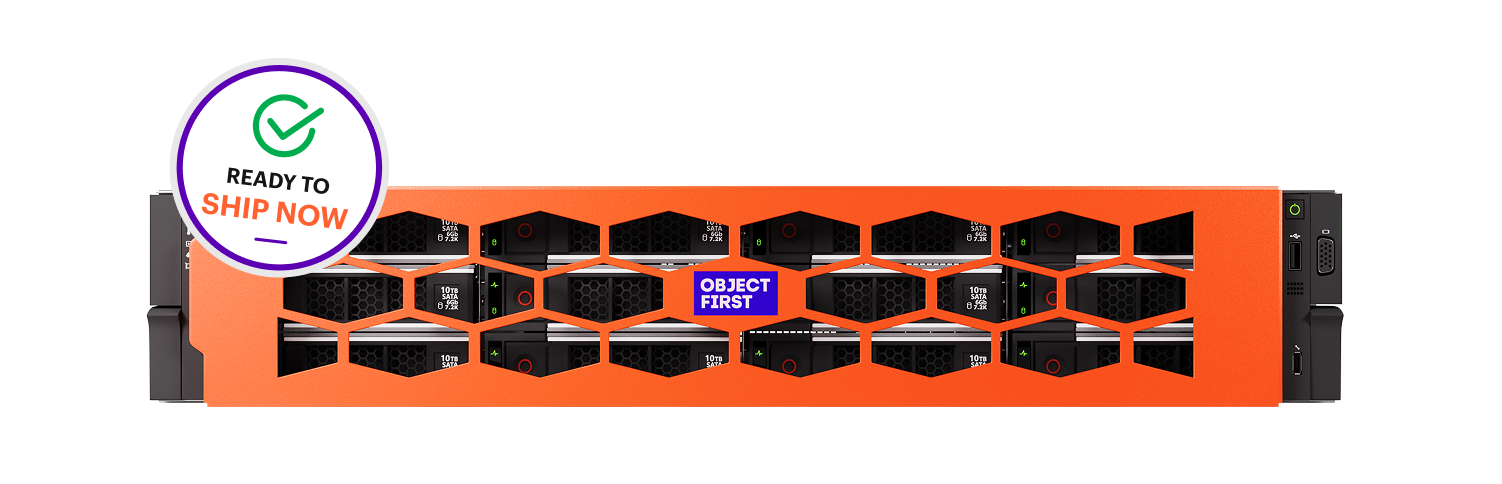
Secure data storage is the practice of protecting stored data from unauthorized access, loss, and tampering. It combines several safeguards, such as encryption, access controls, and immutable storage, so the data stays private, intact, and restorable.
Achieving secure data storage for backups requires three core properties:
Confidentiality: Only authorized people can read the data.
Integrity: The data cannot be changed or corrupted, so a restore returns exactly what was stored.
Availability: The data is accessible when needed, including in the hours after an attack, when recovery matters most.
Miss any one of the three, and storage is not truly secure, leaving it vulnerable to ransomware and other causes of data loss.
According to a 2025 Sophos study, attackers tried to compromise backup data in 94% of ransomware attacks—and 57% of those attempts succeeded. [1] The infrastructure most teams rely on for recovery is typically targeted first by cyber criminals, yet the controls meant to protect it often fall short when under attack.
Encryption is one example. It scrambles data so a thief who steals a copy cannot read it, but it does nothing to stop that data from being deleted or overwritten. An attacker with valid credentials can wipe encrypted backups just as easily as plain files.
Access controls are similar. They grant entry to whoever presents valid credentials, so a stolen or phished login is treated as authorized. From there, the attacker holds the same power to alter or delete backups as a legitimate administrator.
Properly secured backups must feature Absolute Immutability so that even the most privileged admin or attacker with access to backup storage cannot modify or delete backup data. As well as being the best way to assure recovery and return to normal operations as quickly as possible, this is fully aligned with the expectations of FINRA, HIPAA, NIS2, DORA, the UK’s Cyber Security and Resilience Act, and similar regulations—along with cyber insurers.
Data storage security starts with knowing what you're up against. The threats below all put stored backup data at risk, and several give attackers a path to the backups an organization would rely on to recover.
Weak passwords, exposed interfaces, and overbroad permissions let attackers in without breaking anything. Once inside, they can move laterally toward the sensitive data. Strong authentication, least-privilege access, and prompt offboarding shrink the attack surface and remove the paths to storage.

Ransomware is the biggest threat to secure storage. In most cases, attackers go after backups first, because an organization with no clean copy to restore from is often forced to pay. This is why ransomware-proof backup storage is necessary.
Phishing is one of the most common ways attackers steal working credentials. A single convincing email can hand over the exact access needed to reach storage and switch off defenses. Training lowers the odds, but no program can ensure credentials never leak, so backup storage must never rely on login credentials alone.

Unpatched systems give attackers a way in that no password can protect. Storage software, the operating system, and firmware each run their own code with their own potential flaws, so any one left outdated is an opening. A secure data storage appliance that is patched automatically by the vendor closes that gap, so a missed update never becomes an open door.

If hardware is stolen, lost, or retired without a proper data wipe, any sensitive information left on it goes with the device. Encryption protects confidentiality by making a lost drive unreadable, while physical access controls reduces the risk of loss or theft. But neither can recover lost data. For backup data, only an off-site copy can limit the impact of a site-wide incident.

The threat here is a trusted insider, not an outside attacker. Verizon found that 35% of breaches involve an internal actor, from deliberate sabotage to a misconfigured retention setting. [2] Because storage-layer immutability denies destructive access even to admins, insider data loss is contained by design during the retention window.
Secure storage is built from layers, not single features. While the following practices all provide protection, absolutely immutable data storage will ultimately ensure that a backup survives an attack.
Limit who can reach the data, and verify every request. Multi-factor authentication, role-based permissions, and security tokens keep unauthorized users out. Treat access as something to prove, not assume, and review permissions regularly so dormant accounts and stale privileges never become an open door.
Encrypt data at rest and in transit using a strong, current standard such as AES-256. Encryption protects confidentiality: if a copy is stolen, it stays unreadable without the keys. It is a necessary control, but it does nothing to stop deletion or loss.
Many vendors claim to offer immutable backup storage, but what they really provide is a policy-based configuration that can still be changed, bypassed, or disabled by administrators or attackers with elevated privileges.
Absolute Immutability, on the other hand, enforces Zero Access by design, not by policy. Even the most privileged admin or attacker with access to backup storage cannot modify or delete data, and this must be independently verifiable through third-party testing.
Layer endpoint protection, network monitoring, and anomaly detection so threats surface early. Some teams use tools like the Object First Honeypot, a decoy server securely separated from the real backup infrastructure, that trips an alarm the moment an attacker probes it.
By default, assume no user or system can be trusted, and verify every access request. Applied to backup storage, a Zero Trust architecture means securely separating backup software from backup storage, so if one is compromised the other can remain secure. Controls enforced at the storage layer must not be bypassed by software-level credentials alone.
When—not if—ransomware strikes, the future of your business, reputation, and career are on the line. Object First prepares you for cyberattack recovery with Absolute Immutability, ensuring your data can’t be altered or deleted under any circumstances.
Object First supports a full range of immutable backup storage requirements from 8TB up to 7PB and beyond. Deploy our storage appliances as scalable clusters to fit your use case—Remote Office/Branch Office (ROBO), SMB, and mid to large enterprises.
We now offer flexible acquisition options—CapEx or pay‑per‑use Consumption. Both deliver ransomware‑proof storage with Absolute Immutability and include updates, support, and on‑site service.
:quality(75))
Object First Ootbi Mini: Small footprint, Absolute Immutability
Object First Ootbi Mini brings the same security‑first architecture and Veeam‑ready design found across the Object First portfolio, giving small businesses, remote offices, branch locations, and edge sites a simple, enterprise‑grade way to protect critical data.
Object First Ootbi Mini delivers absolutely immutable, ransomware‑proof backup storage in a desktop‑friendly appliance built for environments where racks, cooling, or dedicated server rooms aren't available.
Ootbi Mini integrates seamlessly into Veeam environments, supports both CapEx and Consumption‑based acquisition models, and pairs with Object First Fleet Manager for centralized visibility across distributed sites.
Thanks to our partnership with Object First, we have peace of mind that our on-prem disaster recovery's integrity is iron-clad and will be there for us in the end.
Secure backup storage not only provides a sure path to recovery after a cyber incident. It also aligns perfectly with compliance frameworks. Regulators have shifted their attention from whether organizations have backups, to whether they can actually recover in the event of an attack.
Object First secure data storage helps meet recovery and data-integrity obligations across major regulatory frameworks, including FINRA, HIPAA §164.312(c)(1), GDPR Article 32, NIS2 Article 21, DORA Article 12 (which adds mandatory recovery testing for financial entities [4]), and the UK’s forthcoming Cyber Security and Resilience Bill [5].
[1] Sophos. "The State of Ransomware 2025." 2025. https://www.sophos.com/en-us/content/state-of-ransomware
[2] Verizon. "2024 Data Breach Investigations Report." 2024. https://www.verizon.com/business/resources/reports/dbir/
[3] European Union. "Directive (EU) 2022/2555 (NIS2), Articles 20 and 21." 2022.
[4] European Union. "Regulation (EU) 2022/2554 (DORA), Article 12." 2022.
[5] UK Government. "Cyber Security and Resilience (Network and Information Systems) Bill." 2025.
